Nabaraj Tamang 🇳🇵+977 984 116 8709

Introduction to Island Peak Climbing

Island Peak, known locally as Imja Tse, is Nepal’s most popular climbing peak.  It is perfect for climbers with less experience or those who wish to climb for the first time.

Our climbing guide will demonstrate the techniques of using climbing gear at Base Camp.  And with your safety in mind, we provide one climbing guide for 3-to 4 climbers – based on the climbers’ experience.

This trip starts by flying into the high-altitude airport at Lukla and takes you to the well-known Namche Bazaar and the highest monastery in the region – Tengboche.

You will get the best views of Mt Everest and surrounding mountains from atop Kalapatthar (also known as the Everest viewpoint) at 5,545 m and overnight at Gorakshep at over 5,000 m. Naturally, no trip to this area is complete without going to Everest Base Camp, which you will also visit

From here, the trip differs from those groups heading only to Everest Base Camp.  Now the climbing adventure begins!  Descend down to Lobuche and cross the Khongma La Pass and on to Chukung Khongma La Pass, considered the most difficult pass among the Everest Three High Passes.

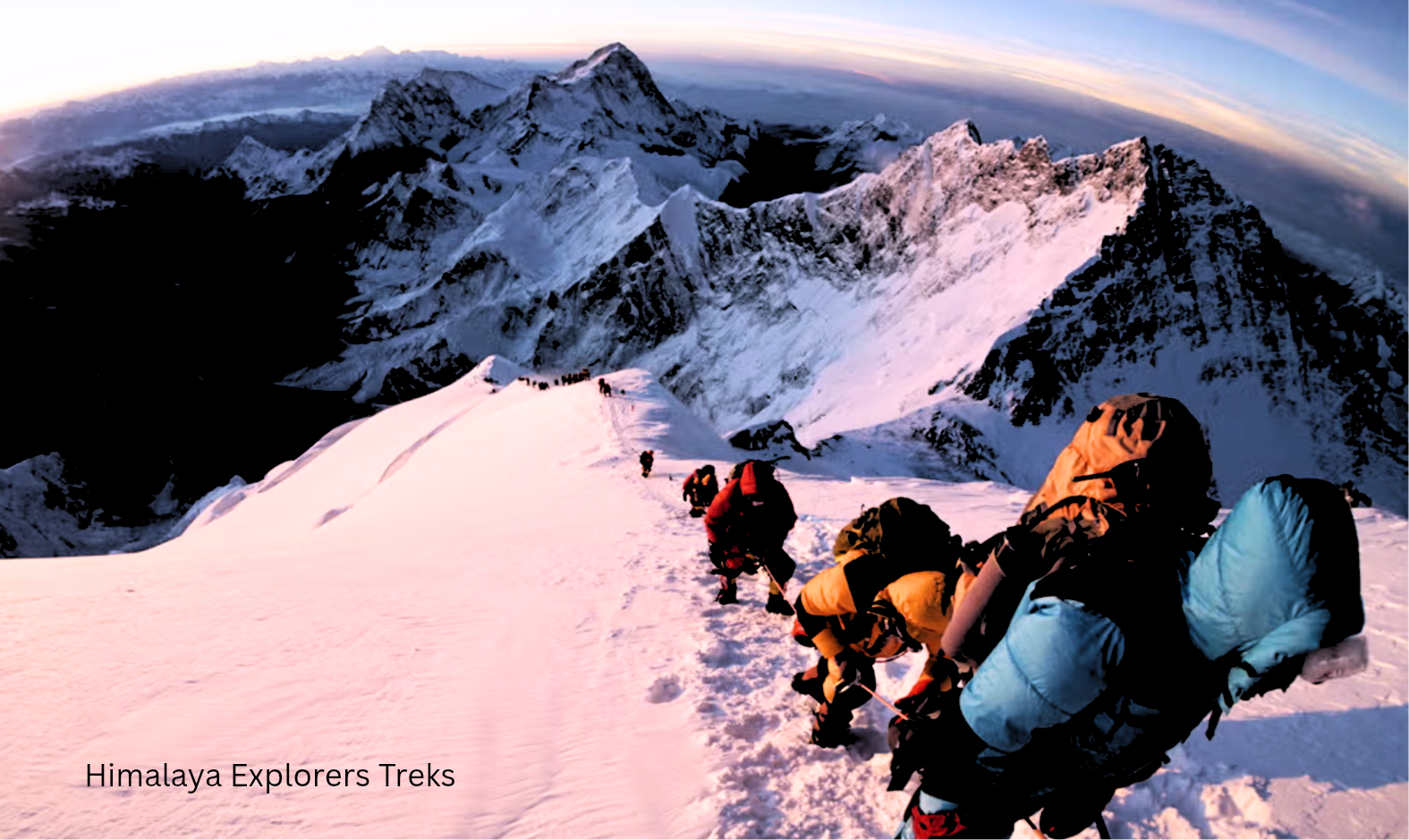
There is only tented accommodation at Island Peak Base Camp as we prepare for the summit.  To reach the summit before the high winds set in, climbers will leave Base Camp around 1 am.

Watching the sunrise over the Himalayas after the exhilarating climb is a once-in-a-lifetime experience. After descending down the Peak and trekking to Dingboche, the route back to Lukla again rejoins the route taken by those on the Everest Base Camp Trek.

The best time to climb Island Peak is April and May, or (followed by) October and November.

Himalaya Explorers Treks works with local Sherpa based in Dingboche and Chukung.  Our Sherpas are highly experienced and know the Island peak inside out.

Island Peak Climbing Highlights

Climbers ready for something longer and higher move on to the Baruntse expedition.
How hard the climb actually is, section by section, is covered in the Island Peak difficulty guide.
  • Hike to Everest Base Camp
  •  Panoramic view from Kalapatthar aka Everest viewpoint
  • Experience Khongma La Pass
  • Summit Island Peak at 6,189 m
  • Island peak is the most popular trekking peak
  • Take in views of Imja Lake, a small glacial lake at the base of Island Peak.
  • Tented overnight accommodation at Island Peak Base Camp
  • Experience climbing in the Himalayas

Island Peak Climbing Itinerary

Day 1: Welcome to Kathmandu! Kathmandu – 1,300 m / 4,265 ft

Today you will be briefed on your island peak climb by our team. You can ask any questions you still have at this point.

Day 2: Kathmandu to Lukla (Flight) to Phakding Phakding – 2651 m / 8697 ft – 35 min + 3 hrs

Departure from Kathmandu by domestic flight is early in the morning. The flight is interesting as you pass over fields, hills, and mountains. Lukla airport is called the Tenzing Hillary Airport after the first two men to summit Everest in 1953. Flying into this high-altitude airport is exhilarating.

Once you land and the gear is unloaded, you head off for a 3 to 4-hour trek to Phakding, where the first overnight stop is. You should be Phakding by lunchtime, but because of the altitude – Phakding sits at 2,651m/ 8,697ft – and the very early morning start, we do not push on today.

Day 3: Phakding to Namche Namche – 3440 m / 11286 ft – 5 to 6 hrs

There is plenty to see today as you walk through pine forests and cross rivers. If you haven’t walked across a suspension bridge, there is plenty to experience today.
The trail enters Sagarmatha National Park by hiking through forests, yak pastures, and Sherpa villages. Looking up, we can see Mt. Thamserku above us. And on to Namche Bazaar.
Namche Bazaar, traditionally a large market town, is the center of climbing andtrekking activities in this region in that all expeditions have to pass through here. You can also purchase last-minute items, such as snacks for your expedition.

Day 4: Acclimatization Day in Namche Namche – 3700 m / 12139 ft – 4 to 5 hrs

It is necessary for everyone to take an acclimatization day before pushing on and up. But acclimatization doesn’t mean lazing around; the best way to acclimatize is to be active. On this day, you can visit the village of Khumjung, where Hillary set up a school for Sherpa children. There is also a health post he was involved in setting up.

Day 5: Namche to Tengboche Tengboche – 3956 m / 12979 ft – 5 to 6 hrs

Leaving Namche with its busy restaurants, shops, and expedition groups, we feel we are entering another country. Here there are signs of Buddhist worship everywhere. As we near Tengboche Monastery along a dust switchback trail, there are shrines, mani walls (prayers carved into stones), and prayer flags fluttering in the wind.

From the monastery itself, the views are stupendous – a whole panorama of mountains. Everest, Ama Dablam, and Lhotse are on display. When you have soaked up enough of the mountain vista, you may wish to light some butter lamps and meet some monks if the time is right.

Day 6: Tengboche to Dinboche Dingboche – 4380 m / 14370 ft – 4 to 5 hrs

Time-wise, this looks like a short day, but the trail is challenging, so be prepared.  Follow the Imja Khola (river) and over desolate fields to Dingboche, the highest Sherpa settlement.  We arrive by lunchtime, so there is plenty of time to relax and stare at the mountains, particularly Ama Dablam.

Day 7: Acclimatization Day in Dingboche Dingboche – 4380 m / 14370 ft – 3 to 4 hrs

Again, we take a day to acclimatize to the increasing altitude. As mentioned, it is best to be active these days, so we recommend visiting Nangkar Tshang Peak, where there are great views of Makalu. This hike will take 3.5 to 5 hours, there and back.

Day 8: Dingboche to Lobuche Lobuche – 4938 m / 16200 ft – 4 to 5 hrs

A challenging trail awaits you today, but it starts off gently through alpine scrub and yak pastures. The Thukla Pass, which you must cross, is 4,830m with stunning views. There are many mountains over 7,000m to see, plus Ama Dablam, Lhotse, and Nuptse, to name just three more.
Having conquered this pass, there is the Thukla Pass to cross. At this Pass, there is a memorial to those who have died on Everest. However, a very simple settlement, Overnight at Lobuche, has a wonderful setting.

Day 9: Lobuche to Gorakshep Gorakshep – 5160 m / 16929 ft – 2 to 3 hr + 4 hr

Today we head to the last settlement before Everest Base Camp, where we will stay overnight. After lunch, we leave Gorakshep and hike to Kala Pattar. This is the nearest we can get to Mt Everest without climbing it.
At 5,545m with stunning views, it is no wonder Kala Pattar is often called Everest View Point. After taking in the fabulous scenery and clicking dozens of photos, we return to Gorakshep for the night.

Day 10: Gorakshep to Lobuche Lobuche – 4938 m / 16200 ft- 4 hrs + 4 hrs

Today we retrace our steps to Lobuche, where we stop again for the night. And again, take in the wonderful views from this simple settlement.

Day 11: Lobuche to Chukung via Khongma La Pass Chukung – 4,730 m/15,518 ft – 6 to 7 hrs

Today there is another day for acclimatization to the high altitude. Sitting above Chhunkung village is Chhukung Ri peak. By climbing this peak, our bodies become acclimatized. Some scrambling is required near the peak’s summit, but the views are amazing, and we can see Ama Dablam and Amphu Labsa peaks. Climbing back down, we retrace our steps to Chhukung, where we spend the night.

Day 12: Chukung to Island Peak Base Camp Island Peak Base Camp – 5,087 m/ 16,690 ft -7 hr

Following the glacial moraine from Chukung, then hiking down to the runoff from Imja Lake, the trails go between some hills before coming out on a sandy plain right at Island Peak and Lhotse.  From here, walk to Island Peak Base Camp which views the Imja Valley.

The afternoon is spent preparing for the climb!

Day 13: Island Peak Base Camp to Summit and Down to Chukung Island Peak Base Camp – 5,087 m/ 16,690 ft

We will summit Island Peak today with the correct weather conditions (6,189m/ 20,305ft).  It’s an early start – 2 am and a long hard climb. There is a rocky scree and steep rocks to scramble over.  When we reach around 5,700m, experience has told us that the high altitude slows the progress considerably.

Finally, we reach a narrow ridge, the start of the glacier, put on crampons and harnesses, and get ice axes and ropes ready to climb across the glacier.  There may be ladders to cross and steep climbing sections to go up and down.

This point can take around 1 to 2 hours before we reach the base of the Headwall.   At the Headwall, it’s possible to take a break while the team fixes climbing ropes.  Finally, climbing up the Headwall, you will reach the summit of Island Peak.  Views are astounding – this is what you have been working towards.

Still roped in because the summit is very small, we abseil down the Headwall, then at the foot, rope together again, and retrace the trail through the glacier.  At High Camp, there is time for a short rest.  The gear will be packed up, and we will trek down to Island Peak Base Camp, where we will stay for the night.  Job well done!

Day 14: Island Peak Base Camp to Pangboche Pangboche – 3,985 m/ 13,074 ft

Following the same route through the valley of Khumbu Khola, today is a much easier day on the body as the altitude gets lower.

We pass Orsho and Shomare villages – both Sherpa settlements.  Depending on the group’s interest, we can visit the gompa in upper Panchoche or take a different trail to reach Pangboche.

Pangboche is a lovely village surrounded by mountains: Everest in the north, Ama Dablam, Kangtaiga, and Thamserku in the east, and to the south, the Kongde range.  We can also see the Imja Tse River flowing through a fertile valley.

Day 15: Pangboche to Namche Namche – 3440 m / 11286 ft

Following the trail from Pangboche, we retrace our earlier steps to the Imja Tse River and through a forest to reach Tengboche. Here we can visit Tengboche Monastery, where we have lunch.
The landscape is full of rhododendron and juniper trees as we head on, crossing the Dudh Koshi River, following the Dudh Koshi gorge, and into pine forests. Here it is possible to see wildlife – and if we are lucky, we might see the Snow Leopard. Finally, we pass the army camp on arrival in Namche Bazaar. Here we relax and enjoy good conversation over dinner – reliving the adventure.

Day 16: Namche to Lukla Lukla – 2860 m / 9383 ft

Today we retrace our original steps – was it really only two weeks ago? We trek down to Lukla and our final night in the Everest Region.

Day 17: Lukla to Kathmandu Flight Kathmandu – 1400 m / 4593 ft

An early morning flight gets us back into Kathmandu by lunchtime, giving us plenty of time to do any last-minute shopping before having a celebratory dinner.

Day 18: Departure Departure

Our staff will ensure you get to the airport on time if you have an international flight. If you are staying longer in Nepal, perhaps you would like to take another trek or tour with us. Just ask!

Not satisfied with this Itinerary? Are you interested on planning custom trip? It only takes 2 minutes. Plan Your Trip

Includes

  • Local transfers for your international flight x 2 (arrival/ departure)Scheduled mountain flights as listed in the itinerary; weather delays are possible.
  • Local transfers for your domestic flight x 2Scheduled mountain flights as listed in the itinerary; weather delays are possible.
  • Kathmandu Lukla Kathmandu FlightScheduled mountain flights as listed in the itinerary; weather delays are possible.
  • Sagarmatha National Park Entry Permit and Local Entry PermitsWe arrange this trekking permit for you before departure, so there is no paperwork on your side.
  • Peak Climbing Permit
  • We arrange this trekking permit for you before departure, so there is no paperwork on your side.
  • Guide for 15 days
  • Licensed, English-speaking local guide, with salary, insurance, meals and lodging all covered.
  • Porter for 14 days
  • One porter carries up to 20 kg for two trekkers, added during checkout.
  • Climbing guide for 3 days (Island Peak Base Camp / return to Base)
  • Licensed, English-speaking local guide, with salary, insurance, meals and lodging all covered.
  • 2 nights accommodation in a Kathmandu (Hotel Dream Nepal or similar)
  • Twin-sharing rooms in local mountain teahouses along the trail.
  • 13 nights accommodation in mountain teahouses
  • Twin-sharing rooms in local mountain teahouses along the trail.
  • 2 night tented accommodation at Base Camp and High Camp
  • Twin-sharing rooms in local mountain teahouses along the trail.
  • Packed lunch on the summit day
  • Three meals a day, chosen from the teahouse menus while on the trek.
  • All cooked meals when camping with complementary hot water, tea and coffee
  • Three meals a day, chosen from the teahouse menus while on the trek.
  • Staff insurance and necessary ground transport for support staff
  • Your policy must cover emergency helicopter evacuation up to 6,000 m.
  • 14 x set breakfasts, 15 x set lunches and 15 x set dinners while on the trek
  • Three meals a day, chosen from the teahouse menus while on the trek.

Excluded

International flight ticket and Nepal entry visa
Tip to Guide and Porter
Personal travel insurance (Which should include coverage for trekking)
Personal climbing gear (can be rented in Chukung/ Dingboche)
Personal expenses
Drinks, snacks, hot showers, wifi, charging, laundry and souvenirs along the way.